The 10 Highest-Reach Products You Could Build on AgentDock
Ten AgentDock product hypotheses picked by how many teams could actually use them, not by editorial fit alone, plus what changed in the runtime since the first product-ideas post.
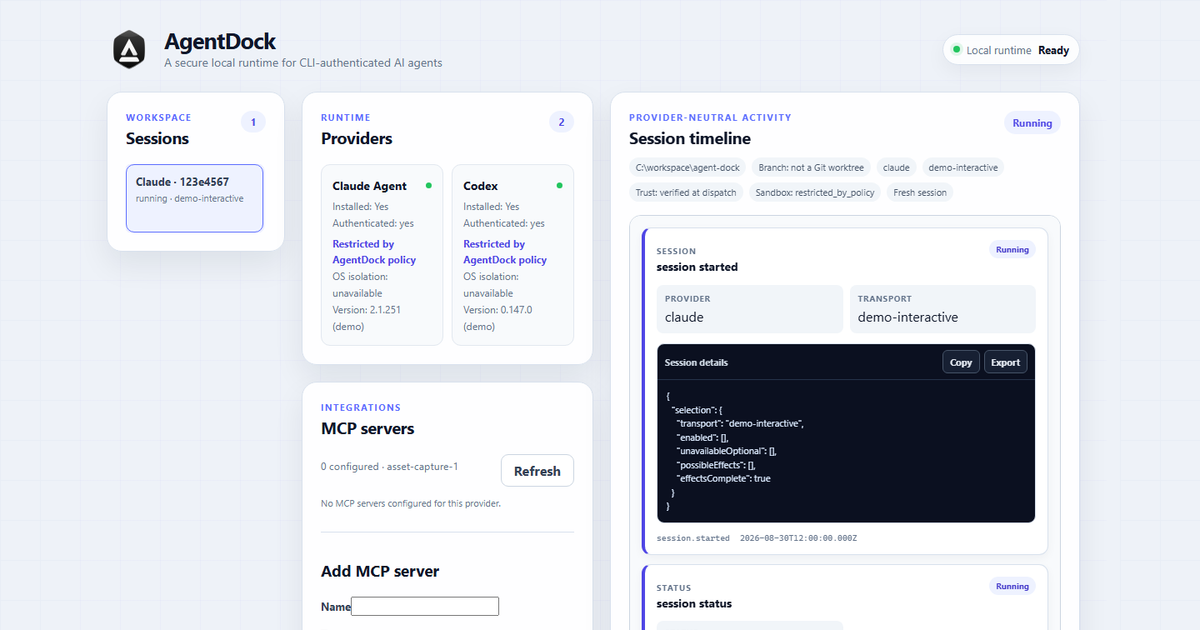
Two days ago I wrote about what AgentDock does and what you can build on it. That post took five product hypotheses from the editorial shortlist in the product concept directory: a Dependency Upgrade Studio, a CI Failure Investigator, a Release Readiness Gate, an Agent Eval and Regression Lab, and an Evidence-to-Brief Studio.
That shortlist ranks by editorial fit. Fit means how well a concept uses the shape of AgentDock’s runtime. It says nothing about how many people could use the resulting product. If you keep going down the fit ranking, the next five are mostly narrow enterprise work: mapping GRC controls, RFP compliance matrices, procurement review. Real jobs, but a small group of specialists does them.
This post picks a different ten, sorted by reach: how many teams or individuals would realistically have a use for each one. Four of them repeat from the first post because they score well on both axes. For those I link back to the full write-up instead of repeating it. Six are new.
What changed in the runtime since the last post
Epic #4, “full-capability Claude and Codex integration,” is closed. All fourteen child tickets landed. In plain terms, the runtime now has:
- the v2 capability matrix and security trust model written down
- the protocol-v2 contracts for capabilities, interactions, and content
- a session supervisor that can send input back into a running provider session, not just read its output
- replay fixtures that check each provider adapter still behaves the same way after a change
- approvals, questions, permissions, workspace trust, and an audit record for them
- native adapters for Codex app-server and the Claude Agent SDK
- a saved timeline of tool calls, content, and artifacts per session
- a saved execution graph, with resume and fork where the provider supports them
- several sessions open at once in the desktop workspace
- an MCP control plane
- read-only inspection of skills, plugins, and hooks
- subagent visualization, with Git worktrees to keep their work separate
- staged multimodal inputs and structured-output validation
The boundaries from the last post still apply. Resume, fork, and interactive approvals depend on the provider and transport you picked. They are negotiated, not guaranteed. But there is a lot more runtime under a fork now than there was on September 1st.
The desktop app also has a “Try a demo” button now. Click it and a fixture bridge swaps in sample provider and session data, including a scripted tool-call approval that holds the timeline until you answer it. A banner stays on screen the whole time so nobody mistakes it for a real session. It installs nothing and needs no provider CLI. If you want to see the pieces every idea below leans on (sessions, streamed events, approvals, saved history), that is the quickest way to look at them.
1. Issue-to-PR Workbench
Turning a well-scoped issue into a reviewable change is the most common agent-assisted workflow in software right now. Any team with an issue tracker could use this.
A first version reads the issue and the repository, proposes a plan, makes the edit, runs the existing tests, and writes the PR material: description, checklist, and a note on what it verified. The maintainer approves what the plan is allowed to change before anything is written, and approves again before anything goes upstream.
AgentDock covers the supervision side with trusted-workspace sessions, worktree isolation, and saved v2 history. The fork owns the issue-tracker integration, the team’s PR conventions, and the definition of “well-scoped enough to attempt.” A vague issue produces a vague plan no matter how good the runtime under it is.
2. Dependency Upgrade Studio
Almost every repository has an upgrade backlog, so a lot of teams could use this. I covered it in the first post: inventory outdated packages, propose one bounded batch, verify with the repository’s own checks, and wait for a maintainer before merging.
3. CI Failure Investigator
Any team running CI has failed builds with the evidence spread across logs, environment, and recent changes. Also from the first post: take one failed job, reproduce it, rank likely causes, and attach proof from a clean rerun. A first version can work from an exported log and a local checkout, before it needs its own CI connector.
4. Bug Reproduction Cockpit
“I can’t reproduce this” comes up on every software team, which is why this one sits high on the reach list.
A focused version takes an unclear bug report, asks structured clarifying questions instead of guessing, captures the relevant environment, writes down a few reproduction hypotheses, runs each one in its own isolated variant, and keeps whatever actually reproduces the problem: logs, a minimal test case, a recorded run.
Worktree isolation matters directly here. Running several reproduction attempts side by side without one polluting another’s state is close to the exact problem worktrees solve. The fork still decides how to generate hypotheses, how far it is willing to go with risky commands while reproducing, and where a “reproduction attempt” turns into something that needs its own approval.
5. Release Readiness Gate
Every team that ships software ends up wanting a versioned go/no-go packet instead of a checklist spread across scripts and people’s memory. From the first post: run the required checks, compare docs against behavior, inspect packaging output, and require a human release decision.
6. UI Quality Workbench
Any product with a user interface collects the same slow problems: accessibility regressions, inconsistent copy, visual drift, localization gaps nobody notices until a user reports them.
A narrow version runs a fixed set of checkers against real screens and source, groups the failures instead of dumping a flat list, proposes fixes for the mechanical ones, and reruns validation to confirm the fix worked. This is close to the exact exercise from earlier this week in AgentDock’s own reference desktop: a placeholder-contrast bug, an undefined CSS class four components depended on, and a color convention that meant opposite things in two different panels. All real, all found by reading the rendered UI rather than guessing.
AgentDock supplies the session, the saved history of what was checked and changed, and the workspace trust boundary. The fork owns the checker set, the judgment about what counts as a real defect versus a style preference, and a way to verify fixes against the real target surface instead of one that only looks similar. I learned that one twice in one afternoon. My verification passed in a plain browser tab while the actual bug only existed behind Electron’s contextBridge. A UI-quality product built on this pattern needs to take that kind of gap seriously.
7. Support Escalation Investigator
A ticket that reaches engineering usually arrives with partial information: a customer description, maybe a log excerpt, and a support agent’s best guess at severity. Most companies with paying customers deal with this.
A focused investigator takes one ticket, pulls the local diagnostics it can reach, tries to reproduce the problem, searches known issues, and prepares a fix or workaround proposal together with a handoff packet: timeline, evidence, and a recommended next step.
AgentDock’s session supervision and provider-neutral event stream keep the investigation visible while it runs. Connecting to the actual ticketing system, log source, and knowledge base is downstream work. A first version can skip most of it by accepting an exported ticket and a local checkout. Customer communication and any account or system change need their own approval gate, separate from the investigation.
8. Evidence-to-Brief Studio
Not every useful agent product touches code. This one applies to research, operations, and analysis work in general. From the first post: turn a controlled project folder into a cited decision memo with an evidence appendix, keeping observed facts separate from inference.
9. Career Application Studio
This has the largest individual audience on the list. Anyone job hunting. That is a large group, and most people go through it more than once.
A version worth building keeps evidence-backed resume variants and work samples locally, matches a target role against verified experience instead of invented claims, points out real gaps, tailors materials per application, and prepares interview research from public sources. The user approves every claim before it goes out. A made-up accomplishment on a resume is a much worse failure than a bland one.
AgentDock’s local-first setup fits this well. A job seeker’s work history and application materials are exactly the kind of data that should stay on their own machine instead of in a hosted product’s database. The fork owns the résumé data model, the matching logic against a role description, and the discipline to keep every generated claim traceable to something true.
10. Academic or Creator Research Studio
Students, independent researchers, and content creators do a version of the same job: turn a private archive and a handful of outside sources into something citable (an article, a lesson, a script) without losing track of what came from where.
A first version collects sources, builds an outline, tracks the source of every claim as it drafts, produces a few variants, and packages attribution with the draft. The author approves interpretation, rights usage, and publication before anything goes out.
This has the same shape as Evidence-to-Brief Studio but a much broader, more individual audience: students and creators rather than analysts inside an organization. The runtime caveats from that write-up carry over unchanged: the fork still supplies its own ingestion path, and citation and rights handling stay on the product side.
Reach versus fit
The original shortlist and this one measure different things. Fit asks how well a concept uses AgentDock’s runtime shape. Reach asks how many people have the problem at all. A Compliance Evidence Workbench can score higher on fit than a Bug Reproduction Cockpit and still reach far fewer people, because almost every developer has hit an unreproducible bug and comparatively few people map security controls to evidence for a living.
Both are reasonable ways to pick a first product. Fit tells you where the runtime does the most work for you. Reach tells you how big the market is before you have built anything. I would use fit to judge how much runtime risk a concept carries, and reach to decide whether that risk is worth carrying at all.
None of these ten are validated products. They are hypotheses, scored against the same practical questions I laid out in the first post.